Melbourne Welcomes a New Chapter for Formula 1
- Amy Yates
- Mar 14
- 5 min read

Welcome to The Motorsport Muse - and to the start of the 2026 Formula 1 season.
This weekend’s Australian Grand Prix at Albert Park marks not only the opening round of the championship, but the beginning of one of the most significant technical regulation changes the sport has seen in decades.
For 2026, Formula 1 has introduced a new generation of cars designed to be smaller, lighter, and more agile, alongside a major shift in the power units. The new regulations move toward an almost 50-50 split between electrical power and the internal combustion engine, significantly increasing the role of energy deployment and electrical performance across a race weekend.
Alongside the power unit changes, Formula 1 has also introduced active aerodynamics. The long-standing DRS system has been removed and replaced with “Straight Mode”, where both the front and rear wings automatically adjust to reduce drag on the straights. In addition, drivers now have access to “Overtake Mode”, a manual boost of extra electrical power available when running within one second of the car ahead.
These changes represent a major reset for teams across the grid - and as the first race weekend unfolds, the competitive order is still far from clear.

The championship begins at Albert Park in Melbourne, a 5.278 kilometre street circuit with 14 turns, hosting a 58 lap race on Sunday. The circuit has historically produced unpredictable season openers, particularly in years where teams and drivers are still adapting to new regulations.
The 2026 season also sees an expanded Formula 1 grid. The arrival of Cadillac as the sport’s 11th team brings the total number of drivers to 22, while Audi makes its full works debut following its acquisition of Sauber - marking another major manufacturer entering the championship.
There is also a meaningful off-track moment this weekend. In recognition of International Women’s Day, which falls on race day, Turn 6 at Albert Park has been renamed “In Her Corner” to honour two leading women in Formula 1 engineering - Laura Muller and Hannah Schmitz.
In this blog, we’ll break down everything from the opening round of the 2026 season: the early competitive picture under the new regulations, the key moments from qualifying, and what to expect heading into the first race of this new era in Formula 1.

Qualifying Breakdown
Qualifying for the 2026 Austalian Grand Prix gave us the first true competitive picture of the grid under Formula 1’s brand new technical regulations. After months of speculation during testing and pre-season development, teams finally pushed their new cars to the limit around Albert Park, and the result was a session filled with surprises, incidents, and an early indication of which teams may have adapted quickest to the new era.
The 2026 regulations introduced smaller, lighter cars and a major shift in power unit balance, with roughly half of the performance now coming from electrical energy. Combined with active aerodynamics and new energy deployment strategies, drivers are still learning exactly where the limits of these cars lie.
Albert Park - a fast, semi-street circuit with tight walls and heavy braking zones - is not the easiest place to discover those limits. And as qualifying unfolded, that challenge became very clear.
Q1 - Early Red Flag and a Huge Exit
The opening segment of qualifying immediately produced one of the biggest moments of the entire weekend.
Just minutes of Q1, Max Verstappen crashed heavily at Turn 1, bringing out a red flag and bringing his qualifying session to an abrupt end.
As Verstappen approached the braking zone for the first corner, the rear of the car appeared to lock under braking, causing the Red Bull to snap sideways. The car spun and made contact with the barriers before Verstappen had the opportunity to complete a representative lap time.
Because the incident occured so early in the session, Verstappen had not yet set a competitive time, which meant he was eliminated from Q1 and will start the race from the back of the grid.
For the world champion and one of the most dominant drivers of the past few seasons, it was an extremely unexpected outcome - and a reminder of just how unpredictable the opening race of a new regulation cycle can be.
After the red flag period, the session resumed with drivers under immediate pressure. With the track rapidly evolving and lap times improving quickly, teams had limited opportunities to secure safe positions.
As usual in Q1, the final minutes saw drivers pushing hard to avoid elimination, resulting in a flurry of late laps. Several midfield drivers managed to improve significantly as the track conditions improved, squeezing others closer to the drop zone.
However, the defining moment of the session remained Verstappen’s crash - instantly turning the race into a recovery challenge for one of the championship favourites.

Q2 - Mercedes Being to Show Their Pace
Once the field was reduced for Q2, the pace of several leading teams became much clearer.
Throughout the session, Mercedes looked particularly strong, with both George Russell and teammate Kimi Antonelli consistently setting competitive lap times near the top of the leaderboard.
The second session also highlighted how teams are still learning to manage the new energy deployment systems. With the increased electrical contribution in the power units, drivers must carefully balance how and where they deploy energy across a lap.
Some drivers struggled to maximise performance consistently, particularly when pushing through the heavier braking zones or exiting slower corners where traction is critical.
Despite those challenges, Russell and Antonelli progressed comfortably into the final session, reinforcing the impression that Mercedes may have started the new era in a very competitive position.
Another standout performance during Q2 came from Red Bull’s Isack Hadjar, who continued to deliver strong lap times and secured a place in Q3. His performance throughout qualifying suggested that Red Bull still have competitive pace, despite Verstappen’s earlier exit.
By the end of Q2, the stage was set for a final ten driver shootout for pole position.
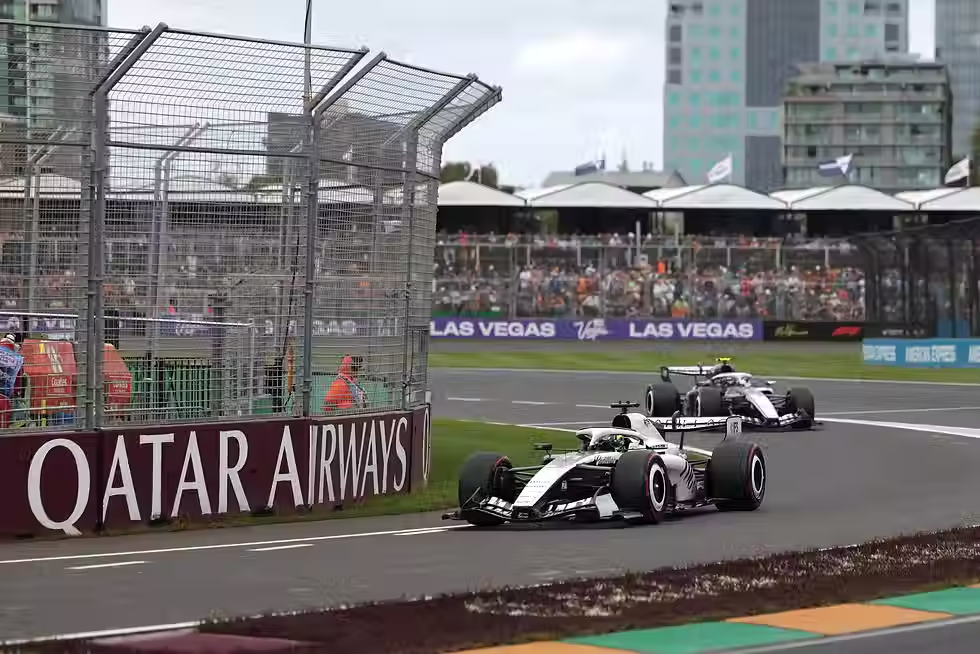
Q3 - Russell Secures the First Pole of the New Era
The final segment of qualifying brought another unusual moment before the fight for pole could properly begin.
At the start of Q3, Kimi Antonelli left the Mercedes garage with cooling equipment still attached to the car. As the car exited the put lane, the devices detache and fell onto the track.
One of the cooling units ended up in the gravel trap at Turn 1, while the other remained on the racing surfaces and was run over by Lando Norris, scattering debris across the circuit.
Race control responded by issuing another red flag so marshals could safely remove the debris and ensure the track was clear before the session resumed.
Once qualifying restarted, drivers were left with a short window to complete ther final runs and challenge for pole position.
In those final minutes, George Russell delivered the decisive lap of the session.
The Mercedes driver produced a clean and controlled lap around Albert Park, setting a time of 1:18.518, which proved fast enough to secure the first pole position of the 2026 Formula 1 season.
Behind him, Kimi Antonelli completed a Mercedes front-row lockout, finishing second and capping off an impressive qualifying performance for the rookie driver.
Antonelli’s result was particularly notable given that he had earlier experienced a crash during final practice earlier in the day. Recovering to qualify on the front row demonstrated both the pace of the Mercedes package and the composure of the young driver under pressure.
Completing the top three was Isack Hadjar for Red Bull, who delivered an excellent performance to put himself directly behind the Mercedes pair on the grid.


Comments